
Analysis: The two largest reservoirs in the US have reached record levels


The second-largest reservoir in the U.S. hit a record low water level on Saturday, just days after the nation’s largest reservoir broke its own record.
Both Lake Mead and Lake Powell are located on the Colorado River.
They provide water to populations in seven southwestern U.S. states, and about 40 million people get some or all of their municipal water from the Colorado River.
The river also provides water to about 5.5 million acres (22,258 square kilometers) of farmland in Colorado, Arizona, California and other states in the river basin.
Experts tell Carbon Brief that climate change, population growth and overconsumption are contributing to current record reservoir levels.
Record lows
At full capacity, Lakes Mead and Powell can hold a combined total of 68 cubic kilometers of water, enough to supply all household consumption in the contiguous United States for nearly a year and a half. However, the water level in both reservoirs has been falling for decades.
The following chart shows the water level of Lake Mead, in meters above mean sea level. The reservoir, which began filling in 1935 after the construction of the Hoover Dam, has a maximum “full pool” capacity of 347.60 meters. The water level in Lake Mead reached a record low of 1,000 feet on August 7.
The graph below shows the water level of Lake Powell, in meters above mean sea level. The full pool level of Lake Powell is 1,127.76 meters.
While the reservoir reached capacity several times in the 1980s, it has not done so since. On August 15, the water level in Lake Powell reached a new all-time low of 1,072.87 meters.
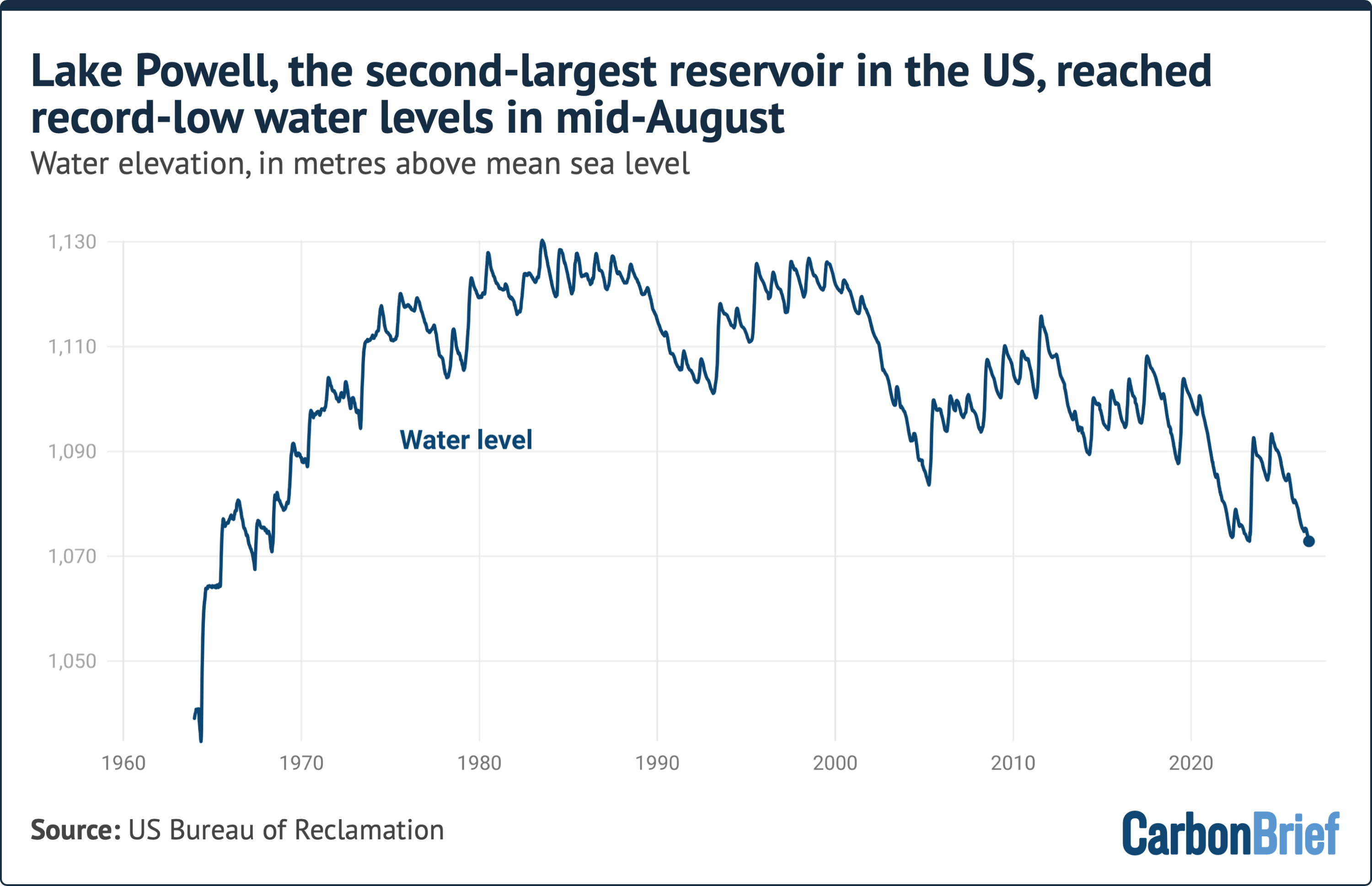
Both reservoirs have continued to fall in the days since they broke their respective records. The downward trend will largely continue in both lakes until next spring, when the snowpack in the mountains of the upper Colorado River Basin begins to melt, says Dr. Jack Schmidt, senior research scientist at Utah State University’s Colorado River Studies Center. He tells Carbon Brief:
“The big dilemma at the moment is that we are only in mid-August, and we are not sure what next winter will be like. The only thing we can be sure of is that we will be depleting the total storage of the basin’s reservoirs between now and approximately the beginning of April.”
Composite factors
The record lows in the two reservoirs are the result of several aggravating factors, experts tell Carbon Brief.
Since the beginning of the 20th century, the amount of water flowing along the Upper Colorado River has decreased by approximately 20%. Research suggests that half of this decline can be attributed to human-induced climate change.
Most of the river’s flow comes from the snowpack of the upper Colorado River Basin, which extends across five western U.S. states but is primarily located in Colorado and Utah.
This region has been affected by a historic “megadrought” for more than a quarter of a century. According to a 2020 study, almost half of the intensity of the megadrought between 2000 and 2018 is attributable to climate change.
At the same time, population growth in the southwestern United States has increased pressure on the Colorado River’s water supply. The number of people getting some or all of their water from the Colorado system has increased by 15 million (about 60%) since 1992.
Schmidt tells Carbon Brief:
“There is an ultimate cause of the current water crisis, and there is a proximate cause. The ultimate cause is a warming climate, a warming planet, and a pretty clear correlation between warming conditions and decreased runoff in the Colorado River Basin.
“The immediate cause is that in this messy democratic republic of ours, big political decisions that adjust to climate variability are made painfully slowly – with intense political negotiations – and only incrementally.”
On July 31, the U.S. Bureau of Reclamation, which manages water resources in the western United States, released an environmental impact statement on its proposed post-2026 strategy for the management of Lakes Powell and Mead. The strategy itself has not yet been published.
Schmidt notes that the declaration appears to give the Bureau flexibility to “respond to the crisis” by reducing water supplies to several states. However, he adds:
“They recognize that it won’t work if we stay critically dry, and of course all the climate models for the 21st century, especially with a continually warming planet, say that’s exactly what’s going to happen.”


